Launch offer — valid today only

📄 Digital book in PDF · read it on your phone or print it

The CCMA, CMA and RMA Clinical Core in Drawings The Numbers and Sequences in the Same Order, Every Time

Vital signs and BP categories, infection control, PPE, the order of draw, 12-lead EKG placement, injection angles and sites, vaccine storage. Every topic gets its own page: the drawing first, then what you need to remember. 58 illustrated pages.

START STUDYING THIS WAY

🔒 Secure checkout · PDF by email · 30-day guarantee

Every topic, its own pageEach skill drawn, with the explanation right beside it
58 illustrated pages8 parts, from the chain of infection to the exam-day checklist
Up-to-date sourcesCDC, CLSI GP41 and the 2017 ACC/AHA guideline
PDF by emailFormat

Look Inside the Book

Every page has one big drawing and a box with the numbers and sequences you need to know:

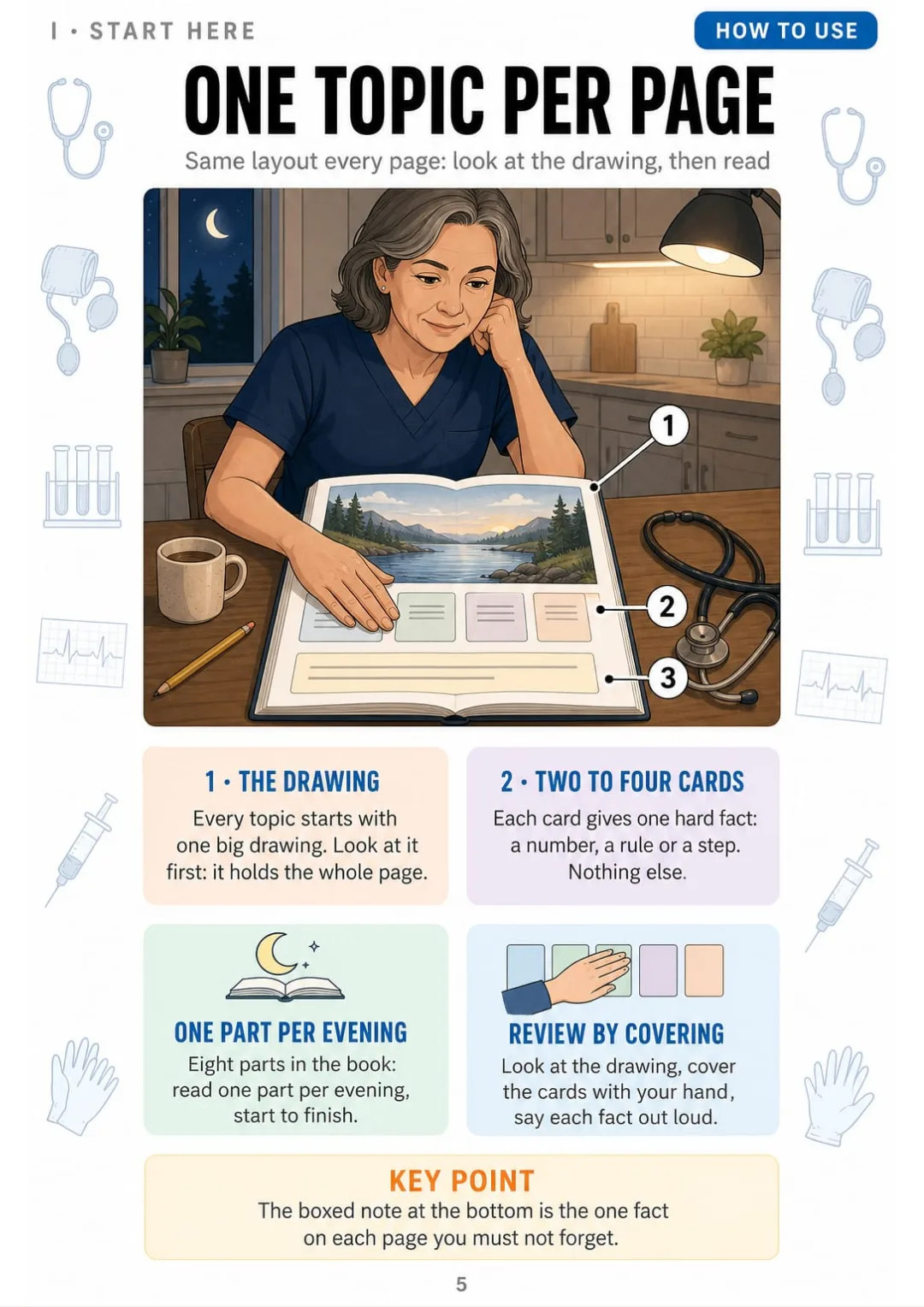
Every page: one drawing, 2–4 cards, one boxed key fact. One part per evening.
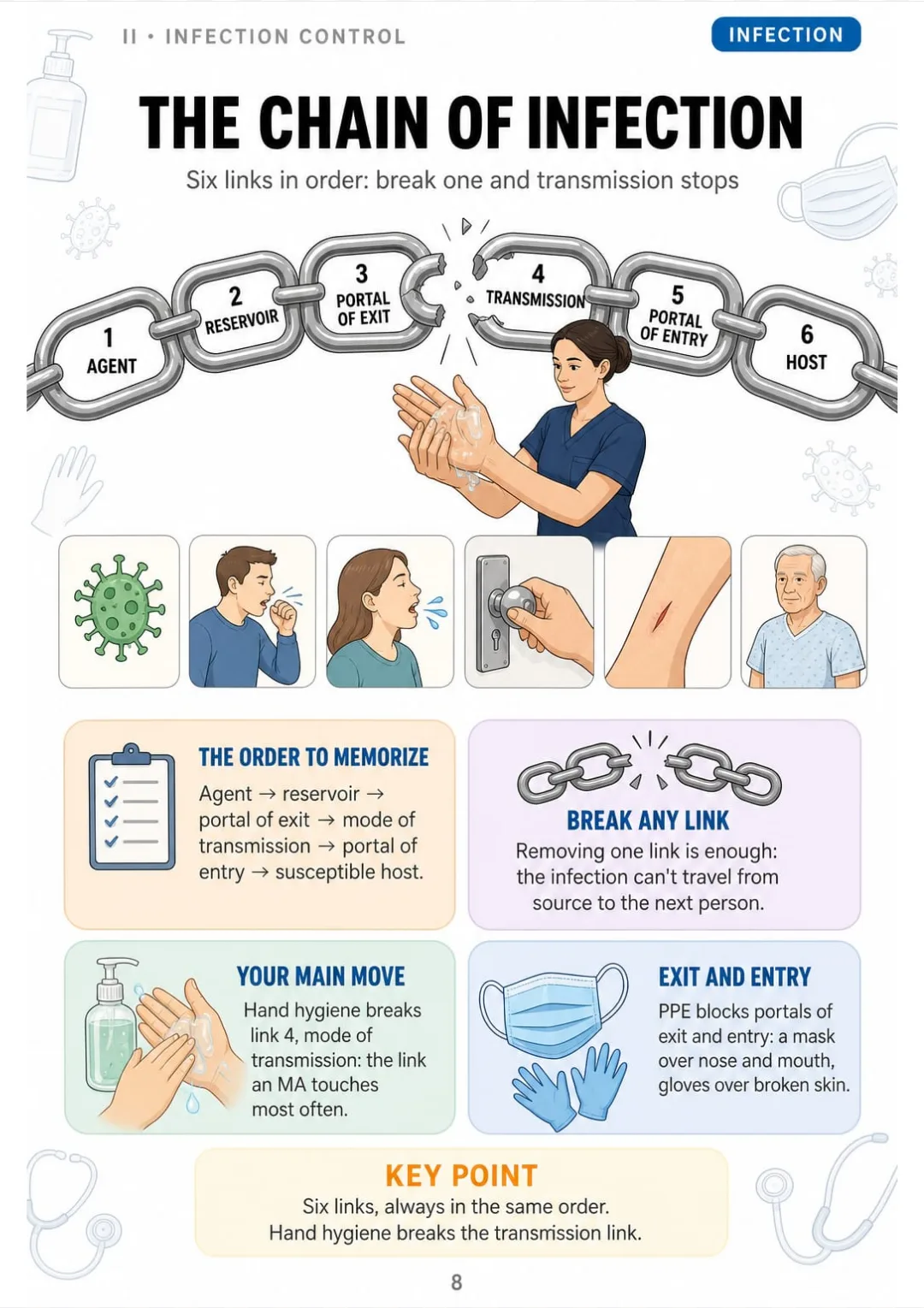
Agent → reservoir → exit → transmission → entry → host: six links, one chain
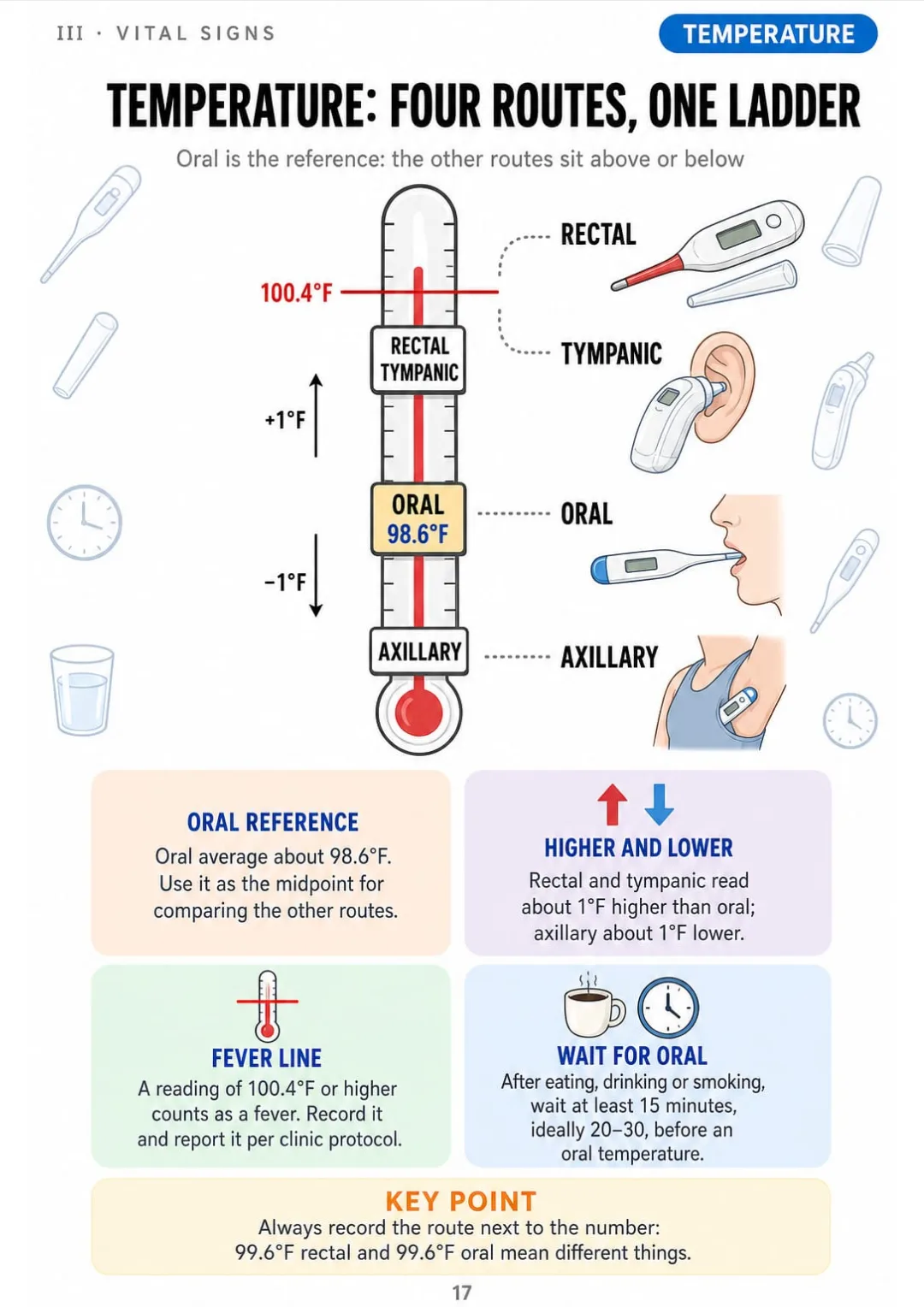
Oral about 98.6°F · rectal and tympanic about 1°F higher · axillary about 1°F lower · fever at 100.4°F
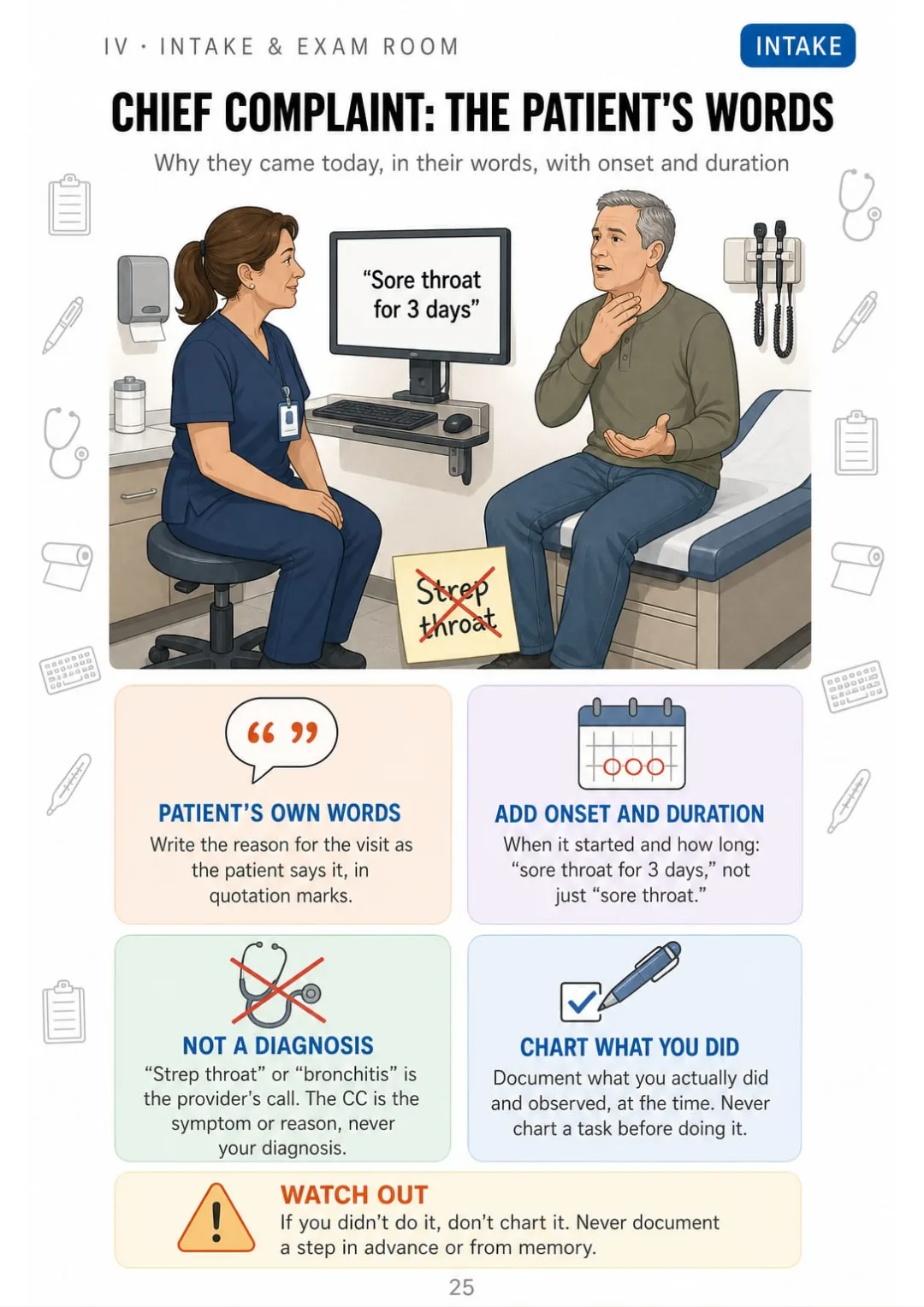
CC = the patient's words in quotes + onset and duration: “sore throat for 3 days.”
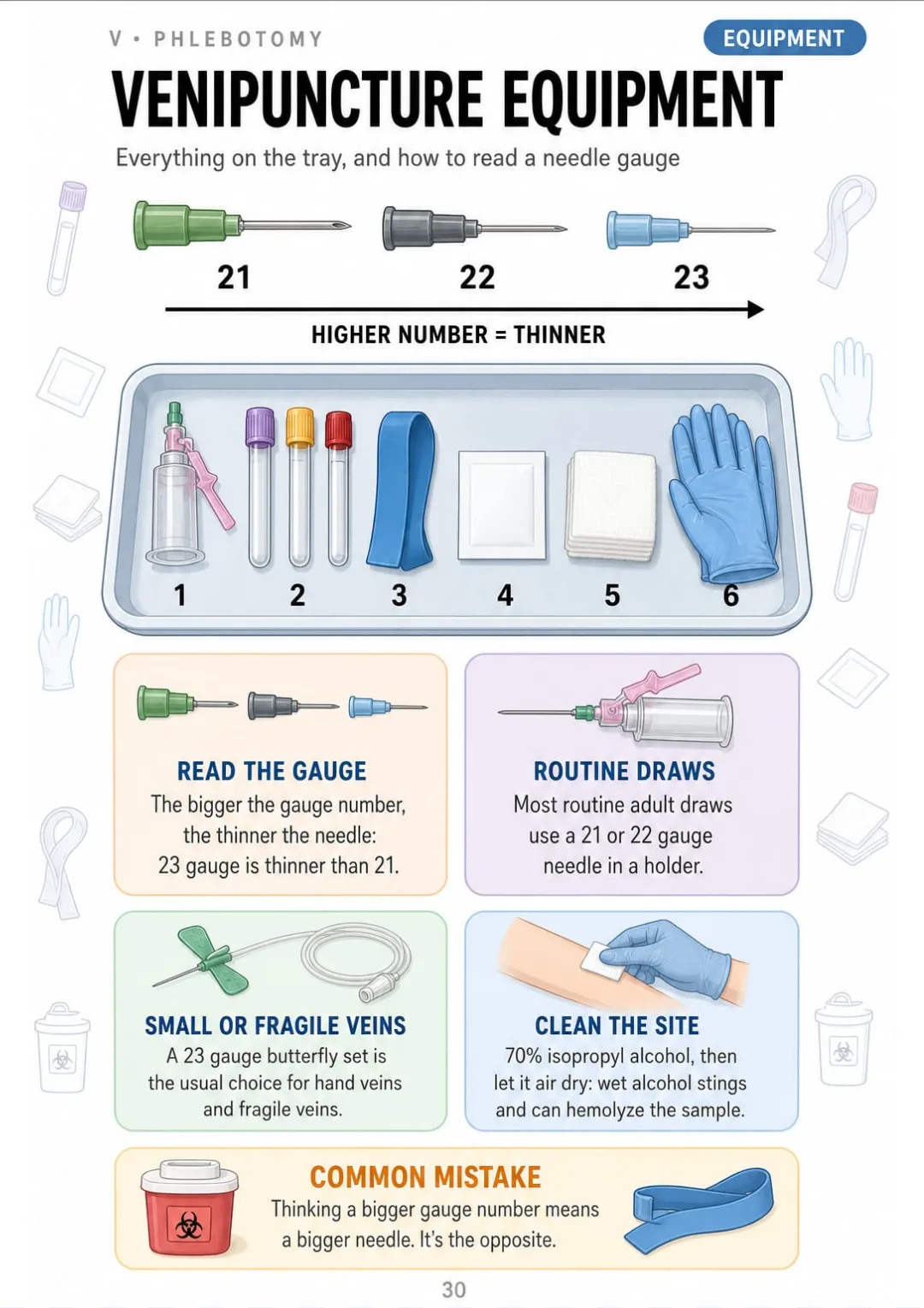
21–22 gauge for routine draws, 23 gauge butterfly for fragile veins, and everything else on the tray.
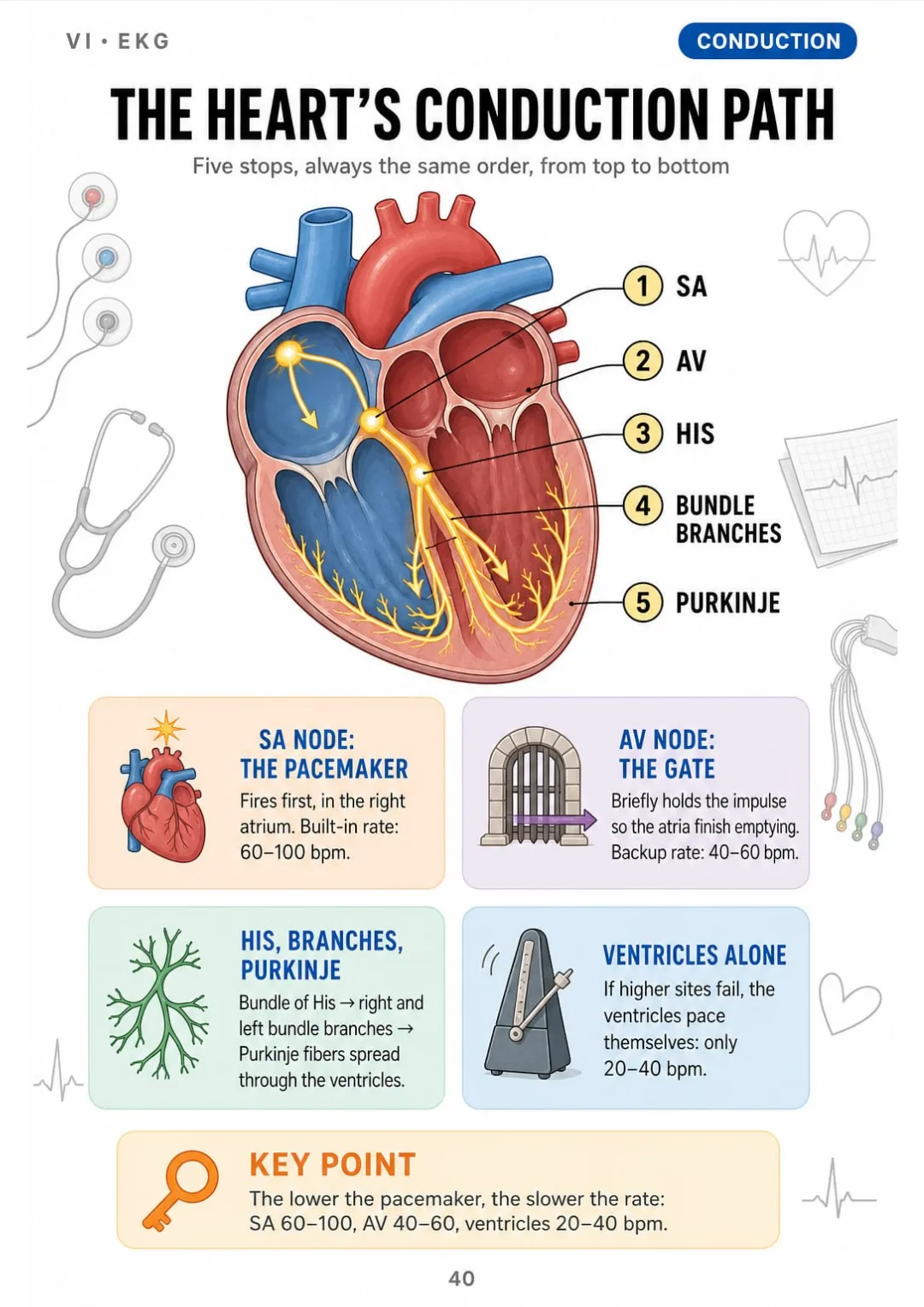
SA → AV → His → bundle branches → Purkinje · 60–100 / 40–60 / 20–40 bpm
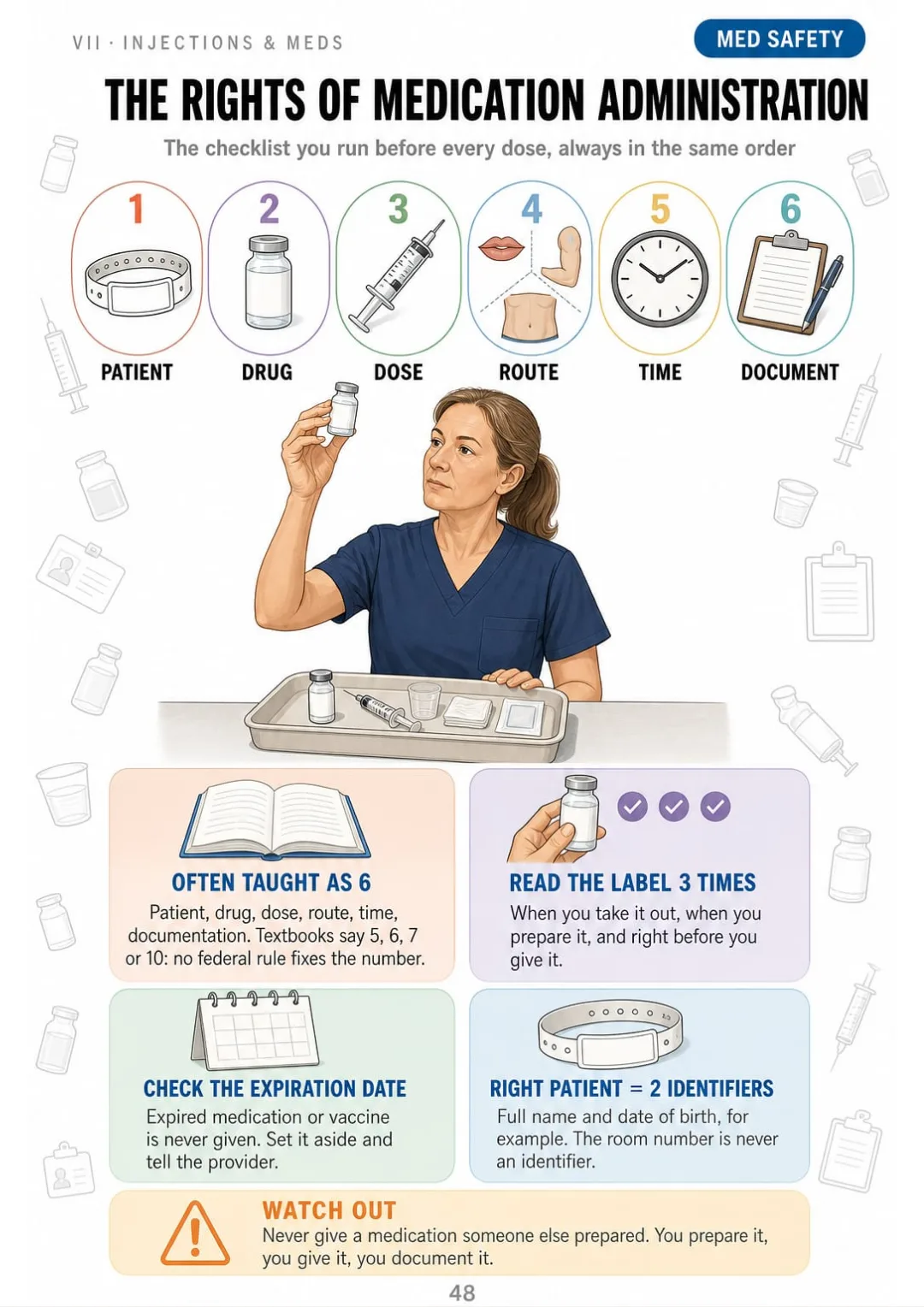
Patient, drug, dose, route, time, documentation + the label read three times
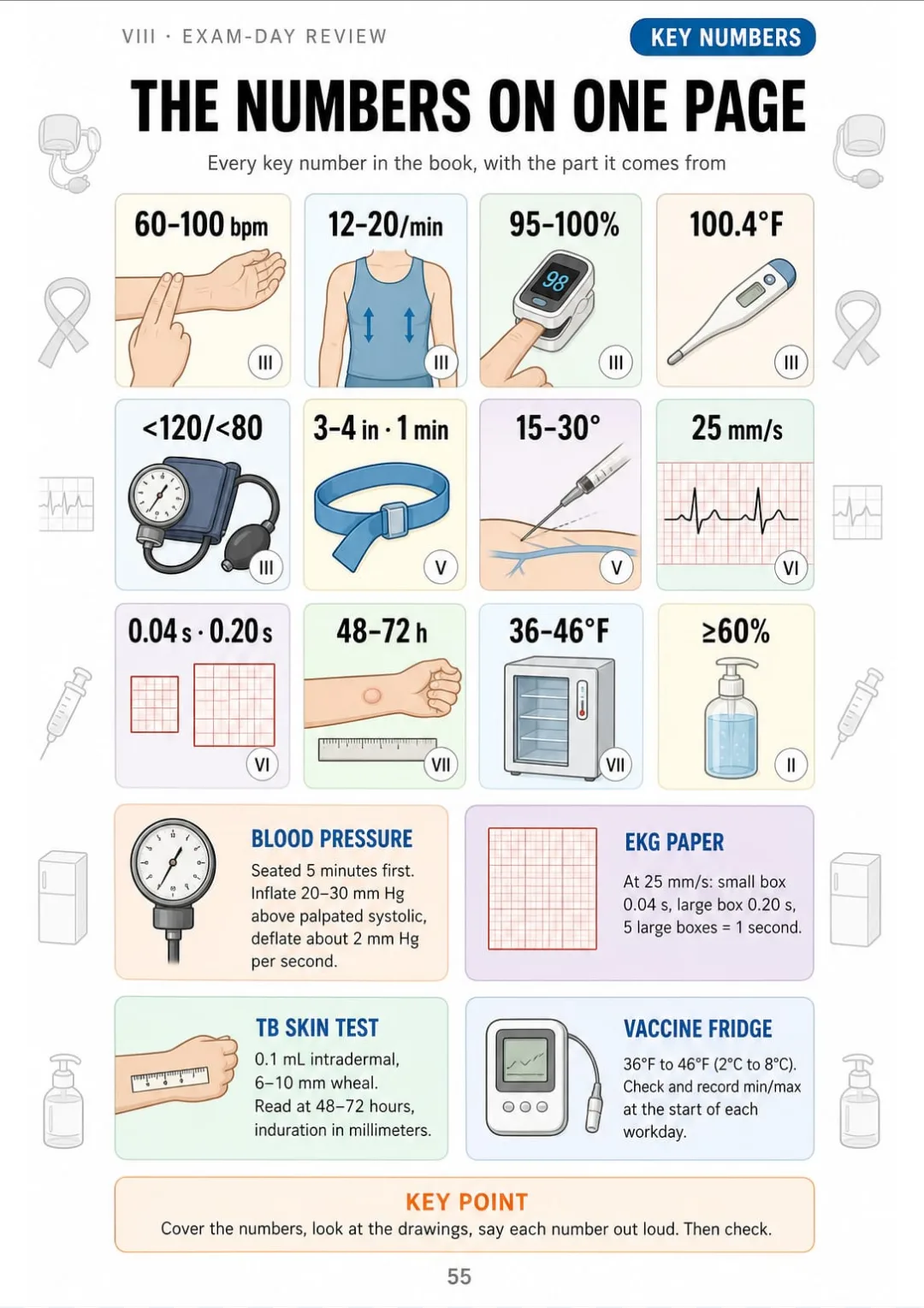
3–4 in and 1 minute, 25 mm/s, 48–72 h, 36–46°F: every number on one page

Swipe to see more →

These are real pages from the book. The table of contents is the full one: 8 parts and 54 topics.

The Problem Isn't You. It's How It Was Explained.

You're at intake, the thermometer beeps and the patient asks: "Is that a fever?" You took it under the arm, and suddenly you're not sure what normal is.

The textbook covered it, in one paragraph: four routes, four values, a fever threshold. Read at night after work, it's just numbers in a row, and numbers in a row don't stay.

Oral about 98.6°F · rectal and tympanic about 1°F higher · axillary about 1°F lower · fever at 100.4°F

In this book, temperature is one page: a ladder with oral at about 98.6°F in the middle, rectal and tympanic one rung up, axillary one rung down, and a red line at 100.4°F.

The same goes for the order of draw, V1 to V6, injection angles, Korotkoff sounds and the PPE sequence: each one has its own page.

You picture the ladder, place the reading on it and know where it sits without opening the textbook again.

COMPARE FOR YOURSELF

Same Topic, Two Ways to Study It

THIS
  • The textbook: line after line
  • Infection control explained only in words
  • You walk into the exam with doubts
The chain of infection describes the sequence of conditions required for an infectious disease to be transmitted. The infectious agent, which may be a bacterium, virus, fungus or parasite, must reside in a reservoir, such as a human, an animal or a contaminated surface, from which it leaves through a portal of exit. Transmission then occurs by contact, droplet, airborne or vector routes, after which the agent enters a susceptible host through a portal of entry. Interruption of any link prevents continuation of the infectious process.
FOR THIS
  • The chain of infection in one drawing
  • The six links in a box
  • Break one link and the chain stops: you see where hand hygiene and PPE fit
Agent → reservoir → exit → transmission → entry → host: six links, one chain
CONTENTS

Take a Look at the 8 Parts and 54 Topics

Start Here, Infection Control & Safety, Vital Signs & Measurements, Intake & Exam Room, Phlebotomy, EKG, Injections & Medications and Exam-Day Review: 58 pages, all illustrated.

IStart Here · pp. 5-7
  1. One topic per page: how to use this book
  2. CCMA, CMA, RMA: one clinical core
  3. Two identifiers before anything
IIInfection Control & Safety · pp. 8-16
  1. The chain of infection: six links
  2. Hand hygiene: soap or sanitizer?
  3. Standard vs transmission-based precautions
  4. Donning PPE: the CDC order
  5. Doffing PPE: dirtiest first
  6. Medical vs surgical asepsis
  7. Sanitize, disinfect, sterilize
  8. OSHA bloodborne pathogens: sharps and needlesticks
  9. Fire and chemical safety: RACE, PASS, SDS
IIIVital Signs & Measurements · pp. 17-24
  1. Temperature: routes and normal values
  2. Pulse sites on one body
  3. Respirations: count without telling
  4. Pulse oximetry
  5. Blood pressure: setting up the patient
  6. Korotkoff sounds: systolic and diastolic
  7. Blood pressure categories (ACC/AHA 2017)
  8. Height, weight and BMI
IVIntake & Exam Room · pp. 25-29
  1. Chief complaint: the patient's words
  2. Exam positions at a glance
  3. Four exam techniques and the instruments
  4. Vision screening: what 20/40 means
  5. The Do Not Use abbreviations
VPhlebotomy · pp. 30-39
  1. Venipuncture equipment
  2. The order of draw (CLSI GP41)
  3. Tube additives and inversions
  4. Choosing the vein
  5. The tourniquet: 3-4 inches, 1 minute
  6. Venipuncture step by step
  7. Butterfly draws and the discard tube
  8. Capillary puncture: sites and a different order
  9. When something goes wrong
  10. Labeling and specimen handling
VIEKG · pp. 40-47
  1. The heart's conduction path
  2. P, QRS, T: what each wave means
  3. Limb leads: RA, LA, RL, LL
  4. Chest leads V1 to V6
  5. 10 electrodes, 12 leads
  6. Reading the EKG paper
  7. Artifacts and how to fix them
  8. Heart rate from a strip and rhythms to report
VIIInjections & Medications · pp. 48-54
  1. The rights of medication administration
  2. Injection angles on a slice of skin
  3. IM sites: deltoid, vastus lateralis, ventrogluteal
  4. Needle gauge and length chart
  5. TB skin test (Mantoux)
  6. Dosage math as a study exercise
  7. Vaccine storage and the VIS
VIIIExam-Day Review · pp. 55-58
  1. The numbers on one page
  2. Sequences to know in order
  3. The most frequent mix-ups
  4. Night-before and exam-day checklist

One Page, One Topic, All Clear

Think of it this way:

Your first week of externship. The provider orders a PT and a CBC, and you need to know which tube goes first before the needle is in.

You open the order-of-draw page and see a row of colored tubes, always in the same sequence, with the light blue top sitting ahead of the lavender.

21–22 gauge for routine draws, 23 gauge butterfly for fragile veins, and everything else on the tray.

The same with V1 to V6 on a torso, the 90° and 45° angles on a slice of skin, the Korotkoff sounds and donning and doffing PPE: each one on its own page.

Medical Assistant Exam Illustrated is 8 parts and 54 topics, all drawn, and it closes with an exam-day review: every number on one page, the sequences in order and the most frequent mix-ups.

What you see drawn, you don't have to memorize.

What's Inside Medical Assistant Exam Illustrated:

Ipp. 5-7

Start Here

How to use the book, the clinical core the CCMA, CMA and RMA share, and the two patient identifiers before anything.

IIpp. 8-16

Infection Control & Safety

The chain of infection, hand hygiene, standard and transmission-based precautions, donning and doffing PPE, asepsis, sterilization, OSHA sharps rules, RACE and PASS.

IIIpp. 17-24

Vital Signs & Measurements

Temperature routes, pulse sites, respirations, pulse oximetry, setting up for blood pressure, Korotkoff sounds, the 2017 ACC/AHA categories and BMI.

IVpp. 25-29

Intake & Exam Room

The chief complaint in the patient's words, exam positions, the four exam techniques, vision screening and the Do Not Use abbreviations.

Vpp. 30-39

Phlebotomy

Equipment, the CLSI order of draw, additives and inversions, choosing the vein, the tourniquet, venipuncture step by step, butterflies, capillary puncture and labeling. The tubes are drawn as one row of colored caps, so the sequence is something you picture, not a list you recite.

VIpp. 40-47

EKG

The conduction path, P-QRS-T, limb leads, V1 to V6, 10 electrodes and 12 leads, the EKG paper, artifacts and heart rate from a strip.

VIIpp. 48-54

Injections & Medications

The rights of medication administration, injection angles, IM sites, needle gauge and length, the Mantoux test, dosage math as a study exercise and vaccine storage.

VIIIpp. 55-58

Exam-Day Review

Every number on one page, the sequences to know in order, the most frequent mix-ups and a night-before checklist.

At the end of the book: Exam-day review: every number on one page, the sequences in order and the most frequent mix-ups.
Plus: 2 Free Books

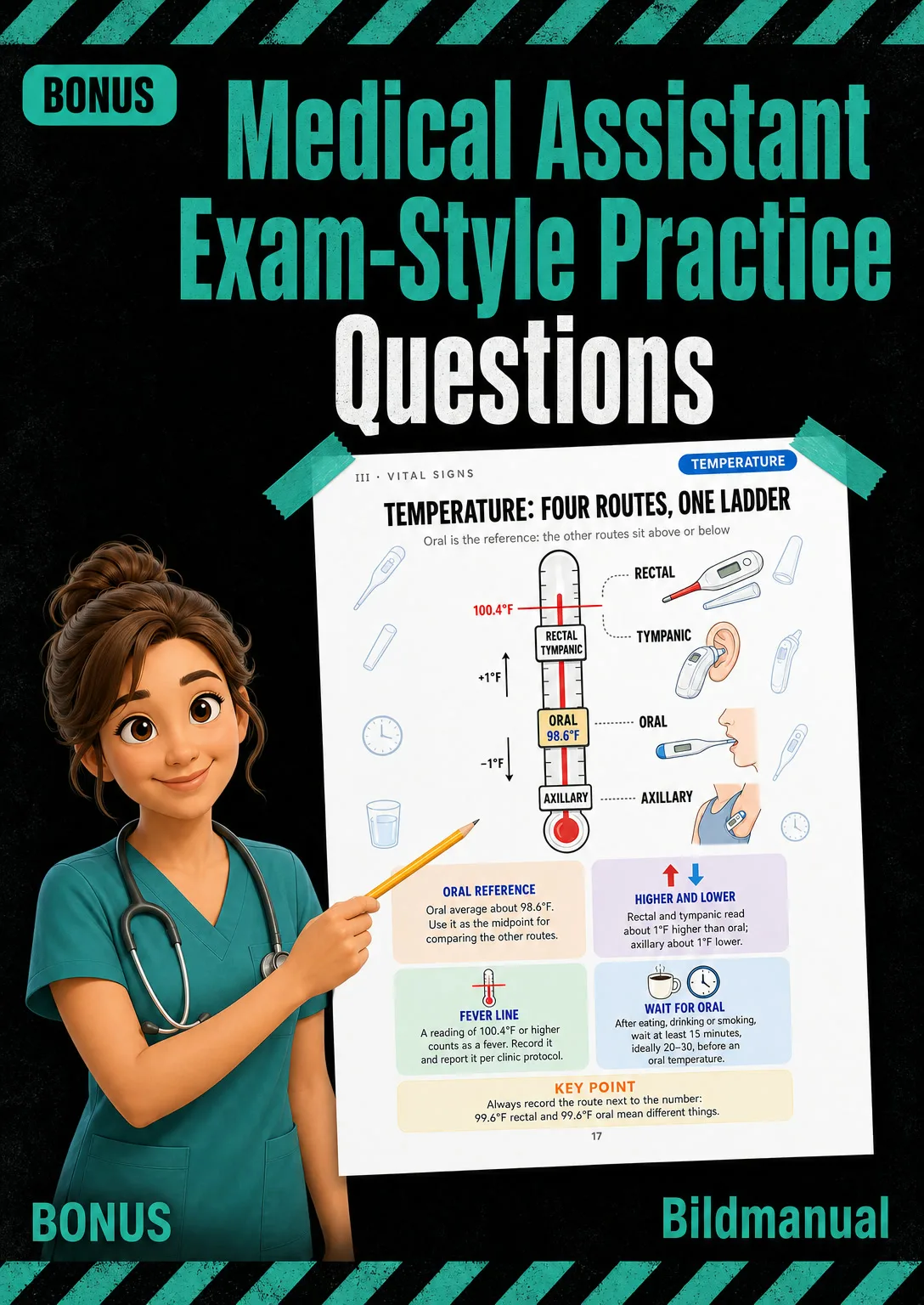
Medical Assistant Exam-Style Practice Questions

BONUS 1: «Medical Assistant Exam-Style Practice Questions»

Value on its own: US$ 17.90

Practice multiple-choice questions on every clinical topic, with the answer and a one-line why, so you can find your weak spots before exam day.

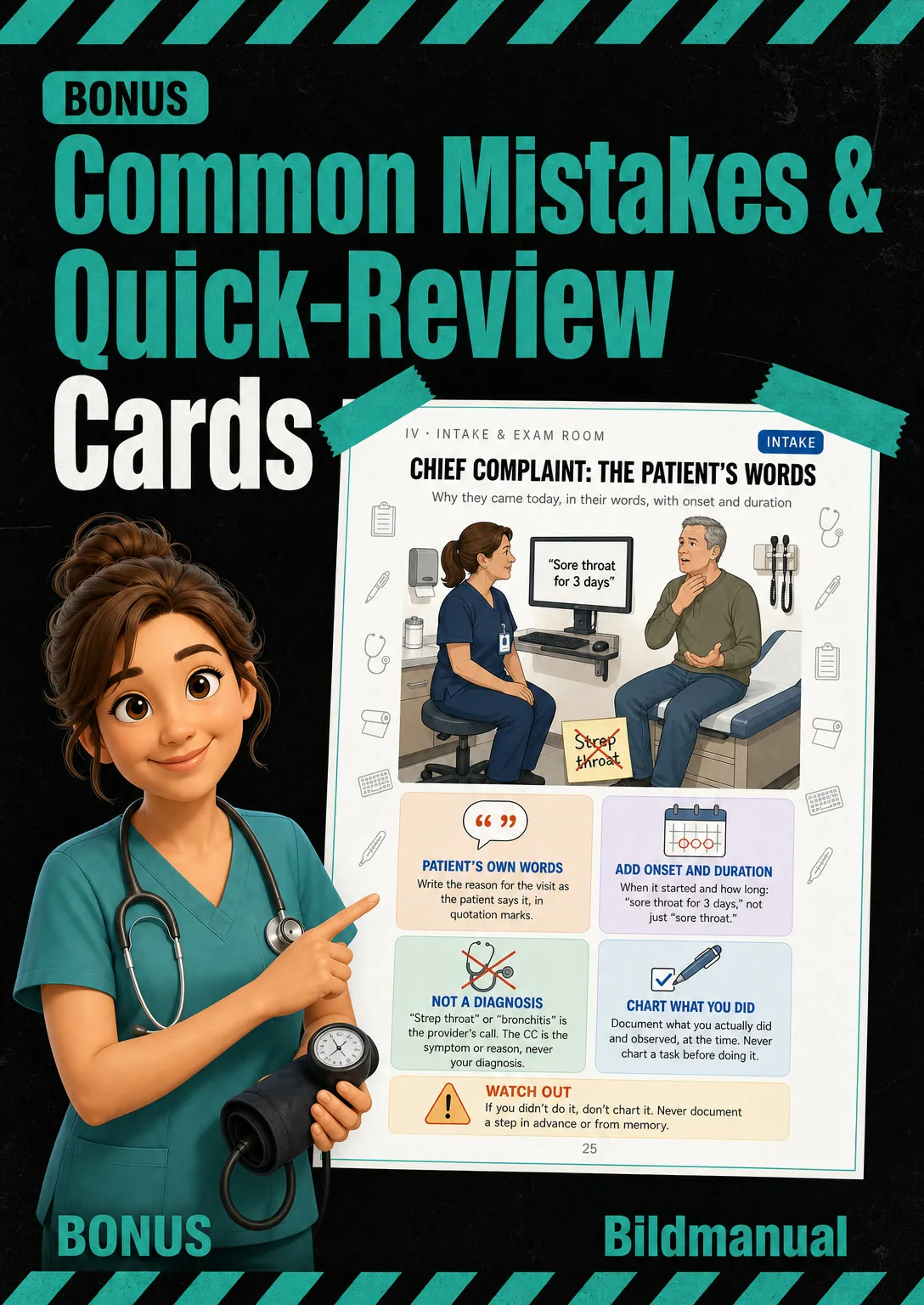
Common Mistakes & Quick-Review Cards

BONUS 2: «Common Mistakes & Quick-Review Cards»

Value on its own: US$ 14.90

The most frequent mix-ups (tube order, V1 vs V2, IM vs subcutaneous angle, doffing order) on printable cards you can review in minutes.

Medical Assistant Exam Illustrated with 2 Free Books

  • Medical Assistant Exam Illustrated: 58 illustrated pagesUS$ 63
  • BONUS 1: Medical Assistant Exam-Style Practice QuestionsUS$ 17.90
  • BONUS 2: Common Mistakes & Quick-Review CardsUS$ 14.90
  • High-resolution PDF to printIncluded
Total value US$ 95.80
YOUR PRICE:
US$ 27
You save US$ 68.80
YES, I WANT MEDICAL ASSISTANT EXAM ILLUSTRATED FOR US$ 27

📄 This is a digital PDF book sent to your email: nothing is printed or shipped.

Secure purchaseEncrypted payment30-day guarantee

PDF by email: We email you Medical Assistant Exam Illustrated as a PDF, together with the two free books. It's a single payment: no installments, no extra charges.

Who This Book Is For

You're in an MA program

You're in an MA program

Each class topic has its own page, so you review the clinical side by looking instead of rereading chapters after work.

Your exam date is set

Your exam date is set

The order of draw, the lead placement and the key numbers are drawn in the same order every time, ready for a quick evening review before the CCMA, CMA or RMA.

You already work as an MA

You already work as an MA

You know the job; the book puts it in the order the exam asks for, so the credential your clinic wants stops feeling like starting over.

Everything You Get Today

US$ 95.80US$ 27
YES, I WANT MEDICAL ASSISTANT EXAM ILLUSTRATED FOR US$ 27

📄 This is a digital PDF book sent to your email: nothing is printed or shipped.

30DAYS
GUARANTEE

30-Day Guarantee

Try Medical Assistant Exam Illustrated for 30 days, bonus books included.

We refund everything if the file won't open, if the book isn't what you see here, if you were charged twice or if the email doesn't arrive. Just email us.

You pay once. No subscriptions.

Frequently Asked Questions

Is this for me if I already work as a medical assistant?

Yes. Whether you've worked for years without the credential or you're finishing a program, it puts the clinical side the CCMA, CMA and RMA share in order and in drawings: infection control, vital signs, intake, phlebotomy, EKG and injections. It isn't a beginner's intro. It doesn't cover the general and administrative sections (billing, scheduling, law and ethics).

Where does the content come from?

From the CDC (hand hygiene, PPE, vaccine storage), CLSI GP41 (venipuncture and order of draw), the 2017 ACC/AHA blood pressure guideline, the OSHA Bloodborne Pathogens Standard and the public NHA, AAMA and AMT exam content outlines. What can't be checked stays out.

Is this official material?

No. It's an independent study book, not affiliated with or endorsed by NHA, AAMA or AMT. It doesn't give you a certificate or CE credits: your credential comes only from passing the official exam.

Does it replace my program or externship?

No. It's a review tool. It doesn't replace an accredited program, your externship, clinical supervision or your clinic's protocols.

Are the practice questions the ones on the exam?

No. They're written for this book, in exam style, to help you find your weak spots. They aren't official questions from any exam.

When and how do I get it?

The book and the 2 bonus books arrive as PDFs by email, at the address you enter at checkout.

Do I have to pay every month?

No. It's a one-time payment. No subscription.

Can I have it on paper?

Yes. It's a printable PDF: print the whole book or just the pages you want to keep in your bag.

How does the refund work?

You have 30 days. We refund everything if the file won't open, if the book isn't what you see on this page, if you were charged twice or if the email doesn't arrive: just email us.

Before You Close This Page

No more rereading without it sticking.

The order of draw: you see it drawn and you're set.

You walk into the exam knowing where everything is.

Drawings make studying faster.

The book is right below.

One-time payment: US$ 27 · Guarantee: 30 days · PDF by email

YES, I WANT MEDICAL ASSISTANT EXAM ILLUSTRATED FOR US$ 27

📄 This is a digital PDF book sent to your email: nothing is printed or shipped.